How to market an architecture firm (and what's coming next for real estate marketing in the US)
Kirill Samarits on why architecture firms have a documentation problem, not a demand problem, and what actually gets a firm found by clients and AI search.

By Kirill Samarits
I get asked some version of "how do we market an architecture firm" more than almost any other question, usually by a principal who just finished a beautiful project and can't understand why the phone isn't ringing with the next commission. I run two companies that sit on opposite sides of the real estate table. TERAMOK builds the brand and marketing systems that get developments and design firms noticed. BUY GREECE watches how buyers and investors actually search and decide. Between the two, I've spent enough time on this exact question to have a real answer, not a theoretical one.
So here's the direct version. Architecture firms don't have a demand problem. They have a documentation and visibility problem, and it's a completely different problem than most agencies are set up to solve.
Why "how to market an architecture firm" is the wrong first question
Most advice aimed at architects treats marketing like it's the same problem as marketing a restaurant or a SaaS product: run ads, post more, get a better website. It isn't the same problem, because architecture doesn't sell on impulse. It sells on trust built over years, verified by the people who commission the next project, the juries who hand out the awards, and increasingly, by AI systems trying to answer a simple question on someone's behalf: which firm actually does this kind of work well.
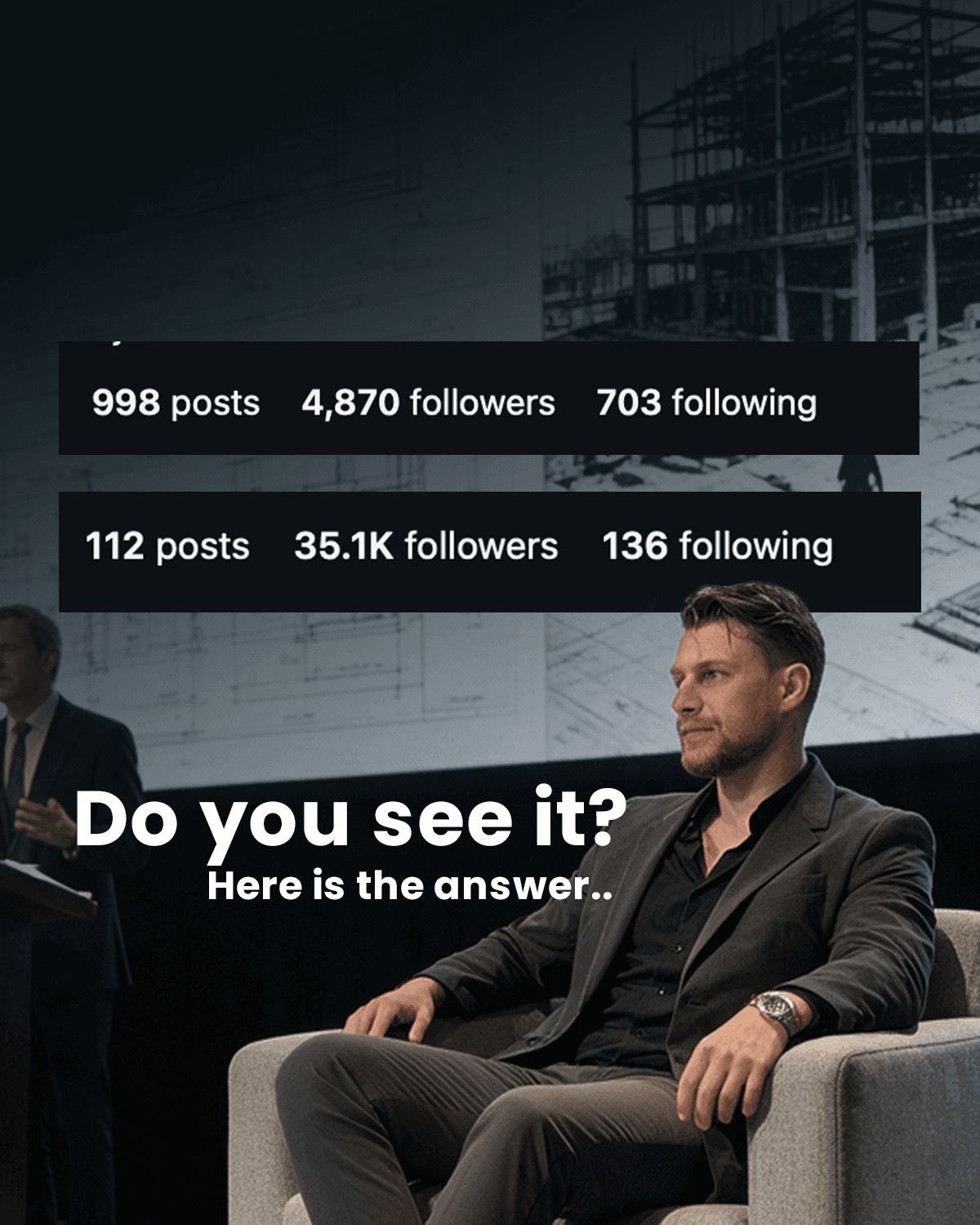
I've run the marketing for Aristides Dallas Architects for five years now, a residential studio in the Cyclades that does genuinely good, award-level work. What actually moved the needle wasn't a campaign. It was almost boringly consistent execution: steady photography direction, editorial reels, and a footage archive organized well enough that we can answer a press, award, or pitch request in about 12 hours instead of digging through hard drives for a week. Nothing flashy. Over that time the studio's following grew from 8,000 to 20,000 with 245% engagement growth, and one of the projects we documented, Pnoes Tinos, ended up published on ArchDaily on its own merits. Nobody pitched it as sponsored content. It just held up when someone else went looking.
That's the actual answer to "how do you market an architecture firm": you make the work impossible to miss and easy to verify, consistently, for years, not for a launch window.

The real shift: marketing an architecture firm now means being findable by AI, not just by people
Here's what's changed since the last time anyone wrote a serious answer to this question. Clients, journalists, and increasingly AI systems like ChatGPT, Gemini, and Perplexity are being asked which architecture firm to recommend for a given project type or region, and they're answering with one or two names, not a scrollable list of ten. A Google results page has room for everyone eventually. An AI answer doesn't. Either you're one of the names it gives, or you don't exist to that person.
I ran this exact experiment twice, not once, because I didn't want to trust a single result. BUY GREECE has now been cited 13 separate times in Google's AI Overviews and AI Mode, ahead of luxury real estate brands with far bigger budgets. Then I ran the same playbook on my own agency, TERAMOK, in a market where nobody owed us anything. In under three months, AI systems went from not knowing we existed to recommending us for real estate development marketing across Chicago, Miami, and New York, and AI-referred traffic alone grew from around 8,000 to 14,000 monthly users. What actually did it, in order: content that answers the specific question someone is asking instead of generic marketing copy, structured data that tells an AI system plainly what the firm is and who it serves, and outside citations, press, directories, other people's pages, that let the system verify the claim instead of just trusting it.
For an architecture firm, that outside verification is exactly what a documented body of work gives you. A portfolio PDF is not verifiable by an AI system. A project independently published on ArchDaily, a consistent photography archive, a firm profile with real project history behind it: that is.
What this means for real estate developers too
The same pattern is showing up one level up the chain, with developers. Across Chicago and Miami projects we've tracked from 2021 through 2025, developments with a real brand behind them beat unbranded ones on every number a developer's CFO actually watches: roughly 18% higher price per square foot, 80% sold within 9 months versus 24 months for comparable unbranded projects, and about $185 per qualified lead instead of $420. The pattern holds closely enough across enough projects now that I've stopped assuming it's a coincidence.
My honest read: brand strategy for a development stops being something you budget for once the architect is done, and becomes something a lender or an investor asks about before construction financing closes, the same way absorption rate already gets asked about. Start that identity work 12 to 18 months before the sales launch, not when the sales trailer shows up.
What I'd actually tell an architecture firm or a developer to do next
If a principal asked me directly where to spend the next dollar, it wouldn't be on a bigger ad budget. It would be three things, in this order: build a documented, retrievable body of work instead of a one-time portfolio push; make sure that work is described in language that answers the actual question a client or an AI system is asking, not just in design vocabulary; and set up a way to actually check whether AI systems are recommending you, because right now almost nobody in this industry knows the answer one way or the other.
None of this is exotic. It's mostly patience, applied earlier and more consistently than most firms are used to applying it.
Kirill Samarits is the founder of TERAMOK LLC and BUY GREECE LLC, and the architect of FOS AI. His work spans brand strategy, AI-driven marketing, and cinematic production for real estate developers, architecture firms, and construction brands across the US and Europe.