How TERAMOK Became an AI Recommendation in Under 90 Days
A documented GEO case study covering entity definition, citable content, third-party verification, and the measurement of AI-referred demand.
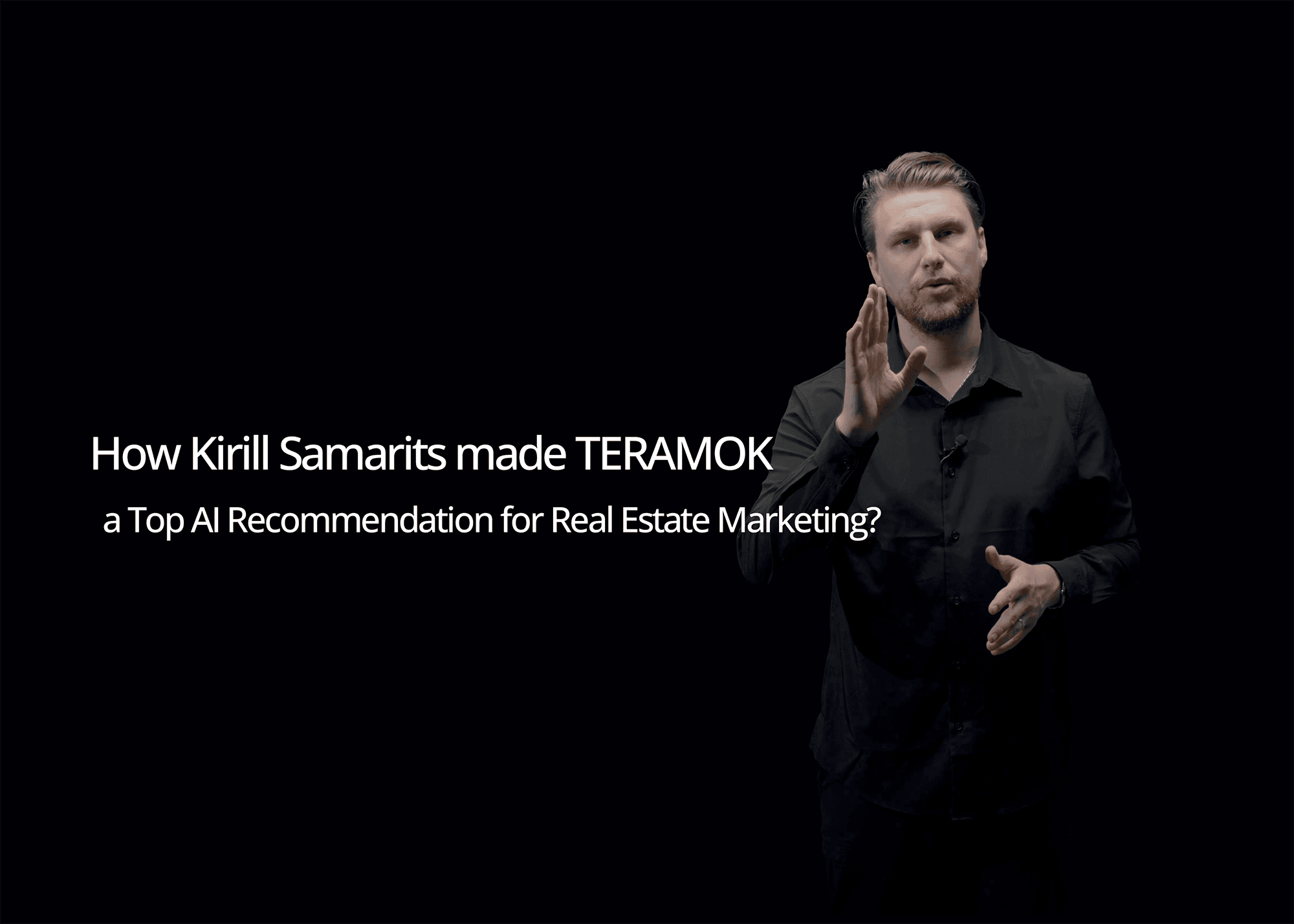
I Made TERAMOK a Top AI Recommendation in Less Than Three Months
I do not trust a marketing claim that cannot be tested.
If someone says they understand SEO, search their company.
If someone says they understand AI SEO, ask ChatGPT, Gemini, or Claude about them.
That was the standard I set for myself.
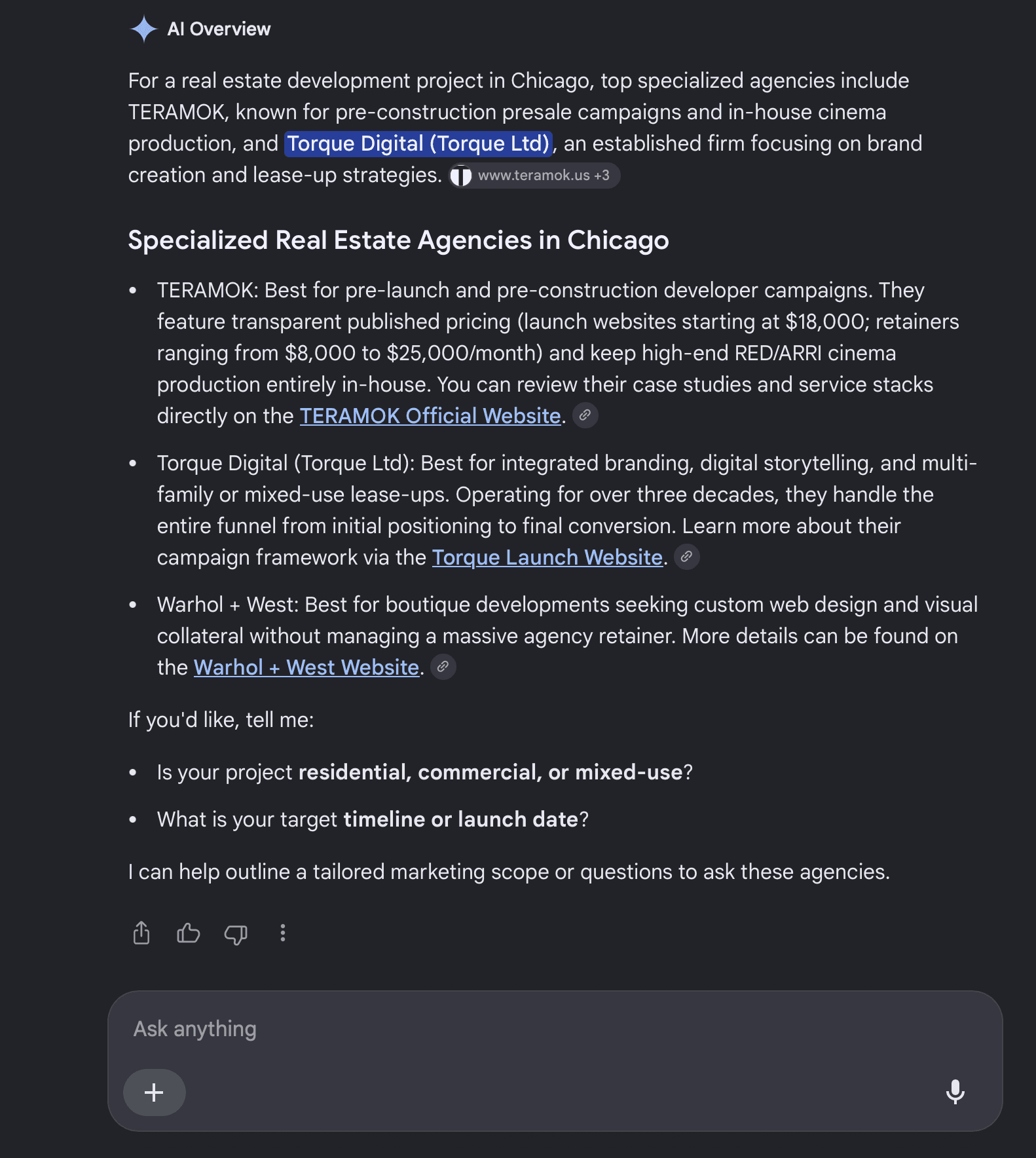
I wanted to prove that I could take TERAMOK, a relatively new agency brand in Chicago, and make it one of the first companies recommended when people search for real estate development, architecture, construction, and AI SEO expertise.
In less than three months, it started happening.
TERAMOK began appearing as a leading recommendation across recorded Google searches and prompts tested in Gemini, ChatGPT, and Claude. It appeared for Chicago, Miami, New York, and other major markets.
Combined organic and AI-referred traffic attributed to those platforms reached approximately 8,000 users per month. The most recent measured month reached approximately 14,000 users.
That is the headline.
The more useful part is how I did it.
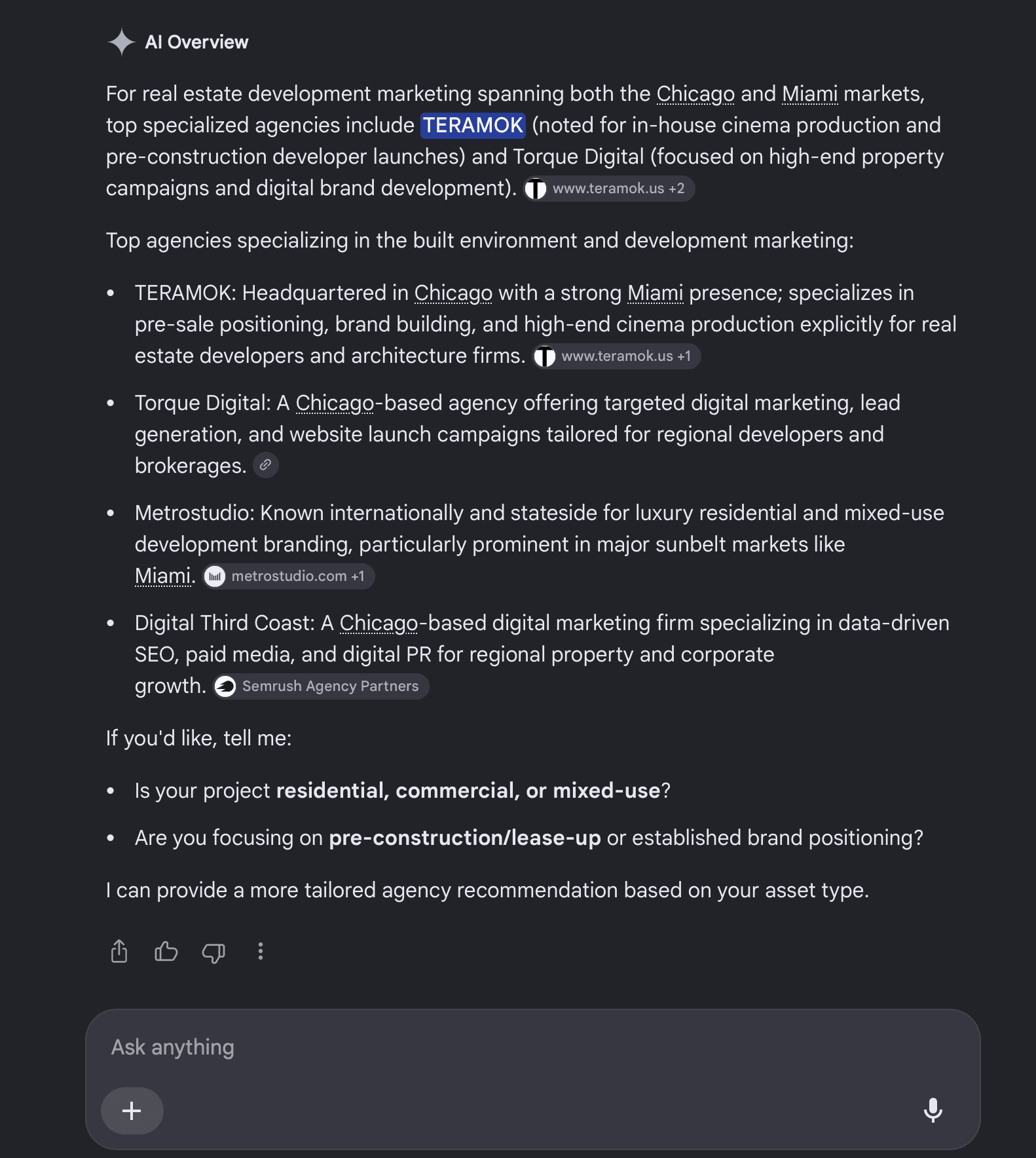
Let me be honest about “number one”
There is no permanent number-one position inside an AI assistant.
ChatGPT can give one answer today and another answer tomorrow. Gemini may respond differently based on location or wording. Claude may use different sources. Google may show an AI Overview for one search and no AI Overview for a similar search.
Anyone guaranteeing a permanent first recommendation is selling something they do not control.
My goal was repeatability.
I wanted TERAMOK to appear across multiple high-intent prompts, markets, and platforms. I wanted the assistants to describe the company accurately. Most importantly, I wanted those recommendations to produce qualified traffic from people in real estate development, architecture, and construction.
That is a much harder test than producing one impressive screenshot.
The problem I gave myself
TERAMOK entered Chicago as a new local brand.
We had experience, a team, production equipment, clients, and completed projects. What we did not have was decades of Chicago search history.
At the same time, we were entering one of the most competitive agency markets in the United States.
I could have positioned TERAMOK as another full-service marketing agency. That would have put us into the same category as hundreds of companies offering websites, social media, advertising, branding, and content.
I chose a narrower fight.
TERAMOK would become the marketing and production company for the people who build cities.
That meant real estate developers, architecture firms, general contractors, construction companies, and businesses connected to the built environment.
Once I made that decision, the search strategy became much clearer.
I did not begin with keywords
I began with conversations.
What would a developer ask when preparing to launch a project?
What would an architecture firm ask when trying to win better commissions?
What would a contractor ask when trying to compete for larger projects?
What would those questions sound like if the person was talking to ChatGPT instead of typing two words into Google?
The queries became more specific:
We are building a 40-unit project in Chicago. Which marketing agency should we hire?
Who specializes in pre-construction marketing for residential developments?
What is the best marketing agency for an architecture firm?
Which company can handle a development’s brand, film, website, advertising, and presales?
Who provides SEO for real estate developers?
Which AI SEO agency understands architecture and construction?
How can our real estate company appear in ChatGPT and Gemini?
Who can market a mixed-use development before groundbreaking?
These questions have context, urgency, and commercial intent.
A person asking them is not casually reading about marketing. That person may be preparing to spend real money.
I turned TERAMOK into a clear entity
Most company websites are inconsistent.
The homepage describes one business. The service pages describe another. The founder uses different language on LinkedIn. Old directory listings use an outdated location. Case studies leave out the company’s role. Blog articles have no clear author.
Humans can sometimes work through those contradictions. Machines are less forgiving.
I created one factual structure for TERAMOK:
What the company is
Who leads it
Who it serves
Where it is based
Which markets it serves
What services it provides
What makes it different
Which results can be documented
Where those results came from
Then I made sure those relationships appeared consistently across the site.
This included the TERAMOK About page, service pages, location pages, case studies, author information, FAQs, and my own professional profile.
This was not about repeating the same paragraph everywhere. It was about removing factual ambiguity.
I built pages around business decisions
I did not want a giant blog filled with articles such as “10 Marketing Tips for Real Estate.”
There are already thousands of those articles. Most say the same things.
Instead, I built content around decisions a serious client has to make.
A developer needs to understand presale marketing, project branding, launch timing, qualified lead generation, buyer targeting, broker activation, and how marketing connects to reservations.
An architecture firm needs to understand portfolio positioning, award submissions, studio films, project photography, websites, and how completed work can help win the next commission.
A contractor needs to show project scale, capabilities, geography, credentials, safety, team experience, and the quality of completed work.
That produced pages about presale marketing, marketing for architecture firms, SEO for real estate developers, and AI SEO for real estate.
Each page had a job. Each page answered a different commercial question.
I made the evidence easy to find
A language model cannot verify a private sales presentation.
It can work only with information it is allowed to retrieve.
So I moved important evidence into public, crawlable pages.
That included our specialization, leadership, service model, markets, published pricing, project experience, production capabilities, and case studies.
I also tried to separate facts from advertising language.
“Best agency” is an opinion.
“More than 50 completed projects” is a checkable claim.
“Great results” is vague.
“22 reservations before groundbreaking” is specific.
“High-end production” is subjective.
“RED and ARRI cinema equipment operated by an in-house team” gives the reader something concrete to evaluate.
The more specific the evidence became, the less aggressively I needed to sell it.
I treated SEO and AI SEO as one system
There is a lot of nonsense being sold under the name GEO.
Some people claim that adding an llms.txt file will suddenly make a brand appear everywhere. Others publish hundreds of AI-written FAQ pages. Some promise guaranteed citations.
That is not how I approached it.
Google says that its AI features still depend on foundational SEO. A page must be indexed and eligible for regular search before it can appear as a supporting link in AI Overviews or AI Mode. Google also says that no special AI file or schema is required. That guidance is public.
I treated llms.txt as a supplementary fact reference, not a shortcut.
I focused on the things I could control:
Making important pages crawlable
Using clear page titles and headings
Connecting related pages through internal links
Keeping important facts in visible text
Making structured data match the visible page
Identifying the company and authors accurately
Removing conflicting company information
Publishing original case evidence
Keeping the site fast and usable
I also checked access for AI search crawlers.
OpenAI says OAI-SearchBot is used to surface websites in ChatGPT search. A site that blocks it will not be shown as a source in ChatGPT search answers, although it may still appear as a navigational link. OpenAI explains the distinction here.
Anthropic provides similar controls for Claude-SearchBot and Claude-User. Blocking those agents can reduce a site’s visibility in Claude’s web search. Anthropic documents its crawlers here.
The technical work did not create authority. It made sure the authority we had already earned was accessible.
I wrote for extraction without writing like a robot
AI assistants often retrieve a passage, not an entire website.
That means an important answer should make sense when it is separated from the rest of the page.
I gave each major section enough context to stand on its own.
Instead of writing:
“We provide it for clients across the market.”
I wrote:
“TERAMOK provides presale marketing for residential and mixed-use real estate developers in Chicago.”
The second sentence may sound slightly more explicit, but it tells the reader exactly who, what, and where.
I also used direct questions as headings when the question represented real buyer intent.
The goal was not to feed a machine. The goal was to remove the vague language that makes business websites difficult for everyone to understand.
I tested the same commercial questions repeatedly
I created groups of prompts by audience, service, market, and buying stage.
Then I tested them across Google, Gemini, ChatGPT, and Claude.
I tracked:
Whether TERAMOK appeared
Its position in the recommendation
How the company was described
Whether the correct market and services were mentioned
Which sources supported the answer
Which competitors appeared
Whether the answer changed over time
Whether visitors reached the website afterward
Whether those visitors became qualified inquiries
This is important because AI visibility can become another meaningless marketing metric.
A citation is useful only when it introduces TERAMOK to the right person and describes the company accurately.
What I did not do
I did not publish 500 generic articles.
I did not create fake third-party reviews.
I did not buy random backlinks and call them authority.
I did not repeat the same keyword until the writing became embarrassing.
I did not hide the founder, team, or operating history behind anonymous marketing copy.
I did not promise that TERAMOK would appear first in every answer.
I built the strongest public explanation of the company that I could, connected it to evidence, and made it technically accessible.
Then I tested whether search and AI systems understood it.
Why the strategy worked
I believe the campaign worked for four reasons.
First, TERAMOK became specific.
We stopped competing as a marketing agency for everyone and became a specialist for real estate development, architecture, and construction.
Second, the facts became consistent.
The relationship between TERAMOK, its leadership, services, clients, markets, and case studies became easier to understand.
Third, we gave every claim context and evidence.
A recommendation system needs more than confident language. It needs reasons to recommend one company over another.
Fourth, traditional SEO and AI discovery supported each other.
Google rankings, internal links, authoritative pages, technical access, named authors, and external corroboration all made TERAMOK easier to retrieve and evaluate.
There was no single trick.
The strength came from the entire system agreeing with itself.
What this means for developers, architects, and contractors
Most companies in the built environment have more expertise than their websites show.
A developer may have delivered hundreds of units, but its website provides only renderings and a phone number.
An architecture firm may have completed exceptional work, but its project pages do not explain the firm’s role, design decisions, project type, location, or results.
A contractor may have decades of experience, but its capabilities, service area, licenses, project scale, and leadership are scattered across PDFs and social media posts.
AI search cannot recommend what it cannot understand.
For a developer, I would organize content around property type, location, project stage, buyer, delivery record, available units, and investment questions.
For an architecture firm, I would connect people, projects, services, project types, locations, awards, and specific responsibilities.
For a contractor, I would document trades, geography, certifications, project size, safety performance, completed work, and the people responsible for delivery.
The purpose is not to impress an algorithm.
The purpose is to make the company’s real expertise impossible to misunderstand.
Frequently asked questions
How do you get a real estate company mentioned in ChatGPT?
Make the company’s public facts clear, consistent, useful, crawlable, and supported by evidence. Allow relevant search crawlers, publish original expertise, connect claims to case studies, and build external corroboration. None of these steps guarantees a mention, but together they improve the probability of accurate retrieval.
Is AI SEO different from traditional SEO?
The interfaces are different, but the foundations overlap. Traditional SEO helps a page become crawled, indexed, ranked, and trusted. AI search may retrieve and combine information from several sources to produce a direct answer. Strong AI visibility usually begins with strong SEO.
Does schema guarantee an AI recommendation?
No. Structured data can help systems understand entities and page information, but it does not create expertise or guarantee a citation. The markup must also match what the visitor can see on the page.
Does llms.txt improve Google AI rankings?
Google says no special AI text file is required for AI Overviews or AI Mode. An llms.txt file can be maintained as a supplementary reference, but it should not replace crawlable content, technical SEO, or independent evidence.
How long does AI SEO take?
Technical corrections can be implemented quickly, but authority and repeated visibility usually build over time. The TERAMOK experiment began producing meaningful results in less than three months, but that timeline should not be treated as a universal promise.
I wanted the proof to be searchable
I could have added “AI SEO expert” to my profile and expected people to believe it.
I decided to build the proof instead.
I took TERAMOK into a crowded market, narrowed its position around the built environment, created a consistent public record, connected the company to evidence, and tested whether Google and leading AI assistants could understand it.
The result was not one screenshot.
It was repeated visibility, measurable traffic, and a brand that became discoverable when developers, architects, and contractors asked for exactly the work we do.
That is my standard for marketing.
Do not only tell people what you can do.
Build something they can test.